Independence and the Colonna’s…a Corsican connection past and present

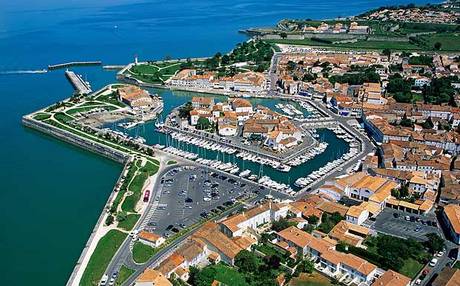
IldeRe-FranceMy family on my father’s side came to America two generations before the Revolutionary War. There is some evidence that they came originally from Île de Ré, a Hugenot stronghold in France, perhaps for religious freedom  So I suppose stories of independence have always been in my blood. Perhaps this is one reason why I have written a novel about the Nationalist movement in Corsica as they also strive to maintain their culture, language, and political freedom from France.

But what is interesting is that Corsica’s centuries of striving for independence is closely tied to the American story of independence from England. The Corsican Constitution, written by Pasquale Paoli, directly inspired the American Constitution. Apparently, American revolutionaries rode to attack shouting, “Viva Paoli”. Several US cities were named Paoli or Corsica or in memory of the Constitution of the innovative small Corsican nation.
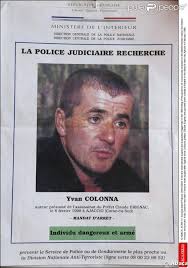
colonna posterAs this celebration of our Independence Day approached, I have had an incredibly interesting exchange of letters with two men, a father and a son, struggling against what they consider the ultimate loss of independence, unjust imprisonment. Yesterday marked the 12th anniversary that Yvan Colonna has been incarcerated in a French prison. He was convicted of assassinating Claude Érignac, the prefect of Corsica, on 6 February 6, 1998.

jean huguesHe is the son of Jean-Hugues Colonna, a former deputy (MP) of the French socialist party in the Alpes-Maritimes constituency and a recipient of the French Légion d’honneur. On 20 June 2011, Yvan’s conviction was upheld on appeal. Yvan is currently serving his life sentence in a prison in Arles.

colonna long hairOn his website, Yvan posted his prison address and since my novel is about a Corsican separatist unjustly accused, I thought I might send him a copy of my novel. The other reason was that when I decided, back in about 2007, to turn my 1996 screenplay “The Coriscan Dagger” into a novel, I happened across a photo of a Corsican separatist on the internet which looked exactly like what I had imagined that my main character, Antoine Scafani, would look like. It was a photo of Yvan, I believe shortly after his initial arrest. He had been the subject of the biggest manhunt in French history, and was thought to have left the country, possibly for South America. However, an infrared camera set in the mountains of Corsica, near Vico as surveillance of a “bergerie“, a traditional Corsican stone hut, yielded evidence that Colonna was hiding here. He was arrested on the 4th of June 2003. As I read more about Yvan’s life, I saw many other similarities. So perhaps my imagination had been right on.

colonna - CopyWithin a week I received a cordial hand written letter back from Yvan stating that although he could not read English that “he would be my man” to translate the novel into lingua corsa if I could first get it translated into French.

And just this past week another package arrived from France. This time from Jean-Hugues Colonna, his father, who at age 80 has taken on the task of writing to those who have contacted his son. His love and unswerving support for his son is quite evident. He included two books that have been written about Yvan’s case. The main gist of their argument is that he was presumed guilty before the trial and therefore a full investigation of other suspects or even the gathering of sufficient evidence again him was not done. He believes that this would never have happened in America, although I’m not sure about that!

Jean-Hugues also shared some other fascinating information about his family back when he was a child during WWII. They had harbored a Jewish family (the island had been occupied by the Italian fascists) and the son of that family became a famous industrialist leader in the United States. He also told me about a camp of American liberators in Cargèse (the Corsican town where he now lives) who gave the children of the village good white bread and tinned pineapple, which they had never tasted before.

Jean-Hugues also offered to translate my novel, or at least a synopsis, into lingua corsa if I can first get a good French translation. An exciting possibility. Even if it all comes to naught, I have been intrigued by this Corsican connection to independence and imagination.

They saved the best for last…

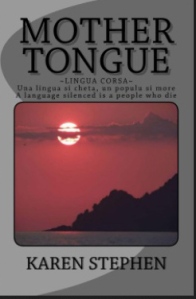
Paperback cover finalSo there I am,,,the 101st pin on the Pinterest Board listing this year’s Nominees for the American Library in Paris Book Award which is given to the best book of the year in English about France or the French-American encounter. Scroll to the very bottom of the Pinterest page to see MOTHER TONGUE.

The blurb: Mother Tongue by Karen Stephen. Child advocate attorney, Liz Fallon, desperately needs a break after legal blunders and her own negligence lead to the kidnapping and death of a mother and daughter she represents. Fluent in her mother’s native Corsican tongue, she nabs a job at a Paris newspaper as a lingua corsa translator for Pierre Benatar, whose coverage of the explosive Corsican Nationalist movement has enraged every separatist faction.

As you can see, I am in very good company. France has served as inspiration for generations of authors. It is a country that embraces and preserves its history, revels in its culture, and is one giant picture postcard that you want to take home.

The “long list” will be announced on Monday, June 15thPlease watch my BOOK TRAILER for MOTHER TONGUE as I wait on Pin..terests and Needles for the outcome. And LIKE my FB author page.

Keeping my fingers crossed…

Paperback cover finalTHE AMERICAN LIBRARY IN PARIS is pleased to confirm your nomination of MOTHER TONGUE for the 2015 Book Award.

We are in receipt of all requirements – nomination form, nomination fee, and 5 copies of your book. These have now been passed to the screening committee.

The longlist will be announced in mid-June 2015 and the shortlist in mid-July. The winner will be announced October 2015.The Book Award jury for 2015, drawn from the Writers Council of the American Library in Paris, is: Laura Furman (chair), novelist, professor at the University of Texas, and editor of the O. Henry Prize Stories series since 2002; Lily Tuck, novelist and biographer; and Fredrik Logevall, professor of international relations at Cornell University and the first winner of THE AMERICAN LIBRARY IN PARIS BOOK AWARD for “Embers of War: The Fall of an Empire and the Making of America’s Vietnam”

Thank you for your submission,
The American Library in Paris

http://americanlibraryinparis.org/
10, rue du Général Camou
75007 Paris | France
t:   +33 01.53.59.12.67
www.americanlibraryinparis.org
@alpbookaward

Short-listed or short-sighted?

FRONT COVER PAPERBACKA blog by crime author Mike Craven has inspired me. He writes of his hilarious adventure attending a banquet honoring those short-listed for a crime-writing book award in London. I too am waiting with bated breath to discover whether my novel MOTHER TONGUE will make the short list for the American Library in Paris Book Award for 2015. The news will be released in July. Although the prize is $5000 and a trip to Paris in October to collect it, there is also a chance that runners up will be asked to do readings at the Library.

So here’s the dilemma. Do I sell one of more of my grandchildren to pay my way should I not win but be invited to do that reading on my own dime? After all, I was invited to submit by the award’s administrator who thought my novel fit right into their rubric of a book written in English about France or the French-American connection. I’ll even admit for a fraction of a second the truth that Corsica is merely a department of France, even though my entire novel is chock full of Corsican separatists who are trying to prove that that particular truth isn’t so by blowing up the Hôtel de Ville in Bordeaux, assassinating each other, and romancing, then terrorizing an American child advocate attorney who is desperately trying to find her missing Liberation (Paris’ radical newspaper) colleague and his young son.

les-deux-magots-eric-feferberg_afp_getty-imagesDo they serve wine in libraries, or more properly bibliothèques, in France? Perhaps not…it is an American library. Would a chance to visit my favorite Paris haunts make the expenditures worth it?  Would I find consolation sitting under the turquoise awning of Les Deax Magots in the company of the ghosts of Jean Paul Sartre, Simone de Beauvoir, and Ernest Hemingway? Only time will tell.

FREE Kindle DOWNLOAD ~ April 4th & 5th ~ Amazon

New cover 10.20 FinalThe KINDLE version of MOTHER TONGUE will be FREE on Amazon Saturday & Sunday, April 4 & 5, 2015. Stop by SATURDAY or SUNDAY on EASTER WEEKEND and download the eBook either of those 2 days.

http://amzn.to/1NExr38 (Amazon.com)

http://amzn.to/19OFStb (Amazon.co.uk)

Child advocate attorney, Liz Fallon, desperately needs a break after legal blunders and her own negligence lead to the kidnapping and death of a mother and daughter she represents. Fluent in her mother’s native Corsican tongue, she nabs a job at a Paris newspaper as a lingua corsa translator for Pierre Benatar, whose coverage of the explosive Corsican Nationalist movement has enraged every separatist faction.

When Benatar and his seven-year-old son disappear, she resolves to prevent another tragedy and cons her way to Corsica under the ruse of researching a tabloid story about the mazzeri, the isle’s ancient harbingers of death. She cozies up to the prime suspects using her secret knowledge of lingua corsa and the aid of an elderly Brit and a courageous teen Corsican cousin.

The hunters suddenly become the hunted when her inquiries arouse the suspicions and passions of both the separatist leader and the French police chief. When the mazzeri story also takes a chilling personal turn, she has to wonder whether Corsica intends to reclaim her as its prodigal daughter or destroy her.

Share the news with your friends. Then download and enjoy, Karen

MOTHER TONGUE back story ~ The author and the Foreign Legion

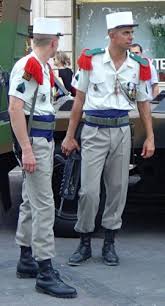
unknowncrewFor a look at the REAL La Légion Etrangère’s 2ème Régiment Étranger de Parachutistes fighting today in Afghanistan, watch this Youtube video. This elite international intervention force is still based in Calvi, Corsica.

The back story for MOTHER TONGUE involved a wild adventure I had at nineteen involving, a British yacht, The Wigeon of Fearn, a “crew” of thirteen dissolute young people, a drunken skipper (seen in the rear of this photo taken at Portofino)–all of whom sailed the Northern Mediterranean, and, among other things, tried to sneak two Foreign Legionnaires off of the island of Corsica! We failed in our mission but I never forgot the many stories of intrigues and foolishness that would evolve eventually into the story of MOTHER TONGUE. I even wrote a poem about our adventure shortly after the voyage ended.

EXCERPT from MOTHER TONGUE: Liz Fallon has just met they mysterious French police officer, Philippe LeClerc, who presents himself as much less than he really is. Their early morning chat takes place on a granite outcropping amid the maquis on the Cap Corse peninsula just after sunrise. They surprisingly find a connection between her mother, his father and the Foreign Legion.

“I have my own story about conscription by the French military,” I said. “My mother’s story actually.”

Vraiment? Tell me.”

two legionnairesI sketched out a few details about my mother and the crew of the Wigeon of Fearn trying to liberate two Foreign Legionnaires from the island, careful to leave the impression that my mother was just another American college kid.

Not until I uttered the words Bonifacio and summer of ’63 did LeClerc respond. “Incroyable! My father was a Lieutenant Colonel in the 2me Étranger du Parachutists, the second airborne of the Legion. He was sent to Bonifacio after the exodus from Algeria in ‘62.”

“Do you think he could have been the officer over the men my mother and her friends tried to sneak off the island?”

He looked off into the distance. “Je ne sais pas.

“So you lived in Corsica then?”

LeClerc paused as though he wasn’t prepared to answer questions about his personal life. I quickly apologized to keep the buttering-up process on track. “I’m sorry, I shouldn’t pry.” Or at least do it more carefully.

“Not at all. The fact is that we never lived where my father was stationed. Although, we visited him that summer. I was nine.” Philippe hesitated again and then changed the subject. “Were your mother’s friends successful?”

“No, someone snitched. It all fell apart. They felt badly because the Legionnaires told them that they woke up with a bad hangover in Marseille and found themselves signed up for six years in the Legion.”

Impossible. The paras were the elite of the Legion, a special intervention force, even back then. No one would have been shanghaied from a bar.”

“And if they’d gotten caught trying to escape?”

“They would have been stripped, placed in solitary confinement, probably suffered a beating. Attempted desertion is still treated very harshly in the Legion.”

I shifted my position on the rock and broke off a nearby stalk of rosemary, twiddling it between my fingers, pleased that I had gotten LeClerc talking about his family. Find out about the father and you’ll find out about the man. “And your father would have allowed that sort of thing?”

“He would have ordered it.”

I wasn’t shocked. I’d known other men, like Briana’s stepfather, with that same sociopathic streak of cruelty.

LeClerc ran his hands over his knees and stared at the rising sun. “My father was something of a legend. He survived Dien Bien Phu and then fought in Algeria against the FLN. He treated his regiment like personal property. He would not have taken it lightly if two of his men deserted. He might even have ordered a corvée de bois.”

“A what?”

“You tell a prisoner he is free to go and then shoot him in the back.”

Now I was shocked. “You’re kidding?”

He looked at me and broke into a sliver of a smile. “Of course. But it makes for a good story, n’est ce pas?”

The Scented Isle ~ in photos and words ~ Calacuccia store

Excerpt from MOTHER TONGUE by Karen Stephen

The moment over, I grabbed the edge of my seat as Scafani barreled ahead, lurching to a stop at a building identified by a sign reading Les Halles Corses. Its façade of stone traveled two feet up white stucco walls and crept around a stout door, propped open to catch the breeze. Two shields, nailed on each side of the entrance, marked it as both a boucherie and a charcuterie.

Scafani opened his door and leapt out. “I’ll be right back.”

I refused to be left behind and reached for my door handle. “I’ll go with.”

He stuck his hand out like a school crossing guard. “No.”

After enduring a terrorizing ride, I sure as hell wasn’t going to be ordered to sit and stay like a friggin’ cocker spaniel. I swung open my door and followed him into the market. He joined a group of grizzled old men seated around a pickle barrel. I headed for the opposite side of the store and busied myself browsing through shelves of canned meat products. I watched out of the corner of my eye as the men greeted him with rounds of kisses on both cheeks and hearty claps on the back.

ResizeDSC02834

A fascinating storefront I captured on my trip to Corsica in 2006.


The Scented Isle ~ in photos and words ~ Bleak village

Excerpt from MOTHER TONGUE by Karen Stephen

The Professor launched into her narration. “I remember there was a dry sirocco wind that day, kicking up swirls of dust all the way along our three-kilometer journey. I worried that my photographer, who shared none of my enthusiasm for the occult, might change his mind and leave me stranded.”

I felt a slight chill go up my spine as the next scene revealed a string of bleak stone houses in a sparsely settled hamlet. The Professor continued. “The inhabitants were nowhere to be seen when we arrived. I knew the men were most likely tending their sheep on the high plateaus. But the women? Were they hiding from me, a stranger in urban dress accompanied by a man holding this strange, whirring machine, or had they caught a glimpse of the solitary figure that approached us?”

I let out an involuntary gasp as a scarecrow of a woman popped onto the screen, her black rags being whipped to and fro by the wind.

village de Muna

Photo Credit: Corse Passion on Facebook, “Village de Muna”


The Scented Isle ~ in photos and words – The Citadelle Corte

Excerpt from MOTHER TONGUE by Karen Stephen

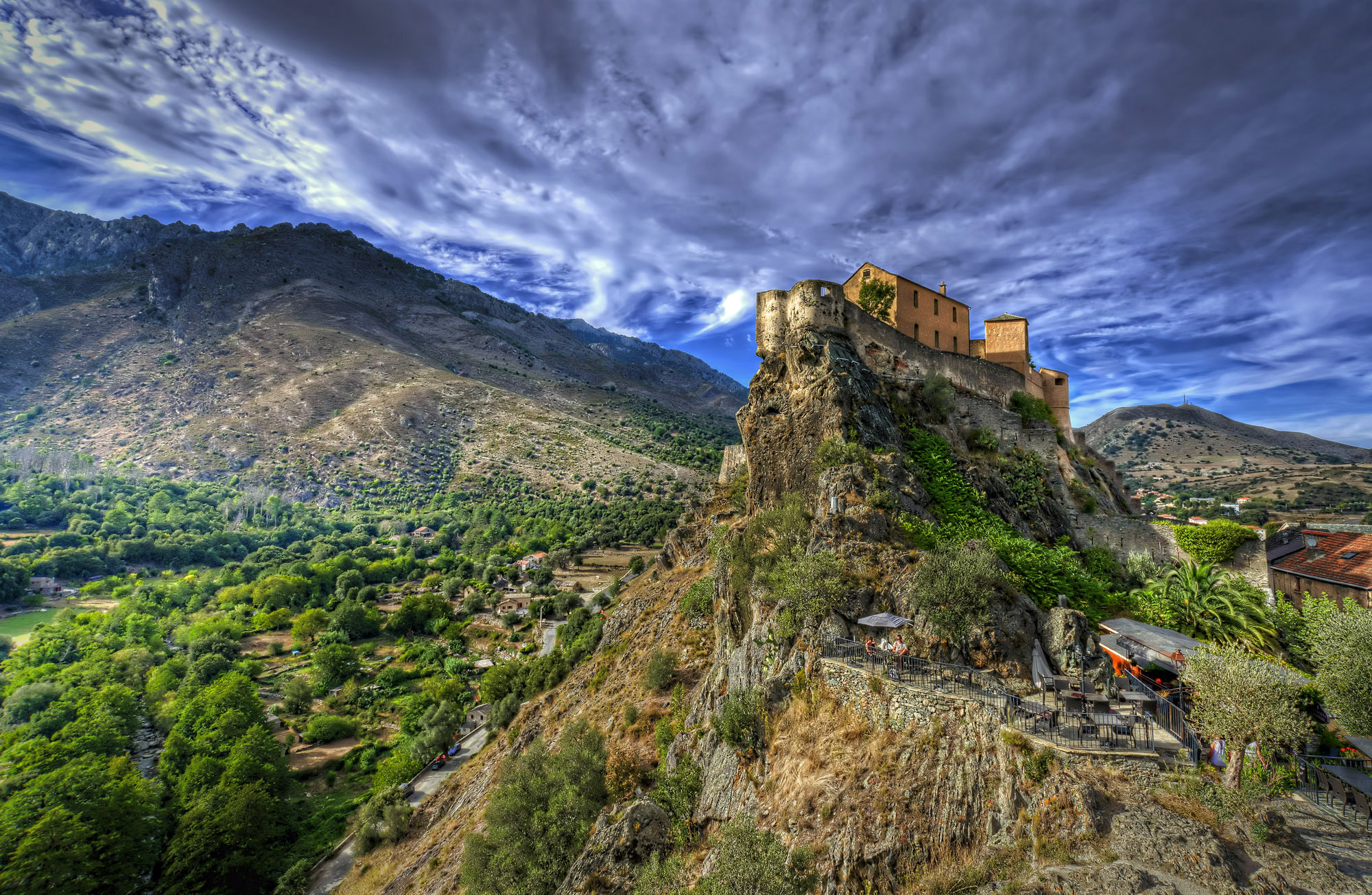
Within minutes I dropped down into a valley and entered the outskirts of Corte. Seeing its sleek, modern buildings dispelled the gruesome images. As I neared the turnoff to the university, I slowed to navigate a roundabout and caught my first glimpse of the city’s Citadelle. The ochre fortress rode atop a wave of rock that soared hundreds of feet above the valley floor, casting a long summer-evening shadow which wrapped its dusky fingers around my car.

Citadelle_2_corte

Photo credit: Les photos de Gaël / HDR / Citadelle 2 corte http://www.deficulturel.net


The Scented Isle ~ in photos and words ~ Monte Rotondo

Excerpt from MOTHER TONGUE by Karen Stephen

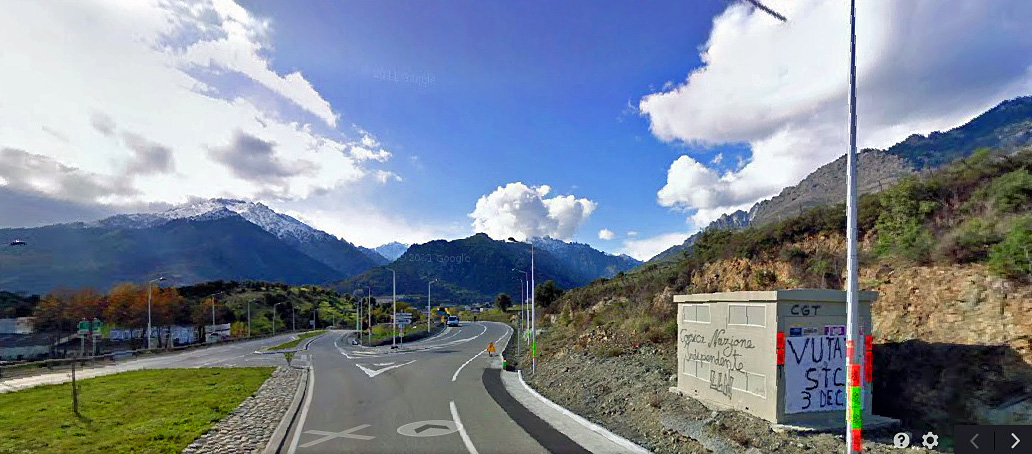
By now the sky turned had deep purple and clouds rose like puffs of steam off a pot of boiling soup. Exiting the next tunnel, a rounded peak still dusted with snow in mid-summer loomed into view. I glanced at the map spread out on the passenger seat. It had to be Monte Rotondo. As I passed each road sign, my eyes lingered on the names of destinations written in both French and lingua corsa: Corte and Corti, Ajaccio and Ajacciu, Ile Rousse and Isula Rossa. A few kilometers farther, a graffiti-covered stone wall, spray painted with the words Cuncolta Nazionale, took me back to Fresnes, which, in turn, triggered disturbing visions of Benatar’s son clinging to his father’s leg as he was being dragged across the very lawn where he had kicked a soccer ball to his Dad the day before.

Mont Rotundo

Another shot as I clicked along N193 from Bastia to Corte on Google Maps until I neared Corte. The graffiti says Corsica Nazione Indipendente. Monte Rotondo lies in the distance, still dusted with snow in the summer.