
 One of my fondest memories from my wacky sophomore year at Cal Berkeley in 1962-63 was chugging $1 a pitcher beer at the Monkey Inn on Thursday nights. Proof that it cost $1 a pitcher is right there on the wall behind the bar in this photo. 25 cents a mug and a guarantee of 5 mugs to a pitcher. Such a deal! My three roommates and I would hop into my 1959 Morris Minor and drive the mile or so from our off-campus digs in a Parker Street duplex just off Telegraph Avenue. This was the year before Sproul Hall and the Free Speech Movement, so frat parties, beer kegs, and panty raids were still in. And I had in hand. not a fake ID. but a real CA driver’s license saying I was 25 that I’d obtained by taking an actual driving test and dressing “older”. Later my mother, viewing a Berkeley police report when I went temporarily AWOL would see a reference to a certain Karen Veazie AKA Karen Scott Billings and would exclaim, “My daughter’s not a criminal!”
Today I decided to do an internet search and see if I could find any reference to the Monkey Inn in that day. And, boy, was I surprised!
 Thursday night was indeed Monkey Inn night. The superb Bill Erickson jazz combo: Frank Goudie (clarinet), Jimmy Carter (drums), Bob Mielke (trombone) and Bill Erickson (piano) held sway Thursday nights at the Monkey from the late 50s up through 1962. Do I remember the music? No. I called my best friend, and she didn’t remember it either. Just the beer and the frat boys (mostly the bad boy Betas AKA Beta Theta Pi’s or the notorious Fijis AKA Phi Gamma Delta’s). Needless to say our little quartet from Parker Street did not represent the prim. round-collared, pearl-bedecked sorority girls of the day.
I found an account that said it was a beer and pizza joint near the Oakland border that was a rough UC Berkeley student hangout with sawdust on the floor and, “fraternity guys out on their first beer benders. It got pretty rowdy sometimes.” I guess no one noticed that there were at least four “girls” out on their first benders as well. The account added that the musicians rarely sounded happier than when playing primarily for themselves, and only secondarily for a mostly indifferent college crowd. Must be why we don’t remember the music.
 But when I read about what happened the next year, I was even more astounded. By 1964 my best friend and I (I’m the tall one!)had returned to La Jolla where we had grown up and found a minuscule apartment under the front stairway of a Spanish mansion across from the famed Wind ‘n’ Sea beach. I attended the 3rd and 4th of my undergraduate schools (yes, Berkeley was school number two after a freshman year at Stanford, but I finally went to grad school, got a Ph.D., and was a therapist for 40 years and still work in the mental health field at age 73–so there!). My best friend got a totally cool job at the new Saks Fifth Avenue store in La Jolla.
Meanwhile back in Berkeley, a new band, known as Blue Velvet, arrived at the Monkey Inn to perform in the Spring and Fall of 1964. Formed by John Fogerty, Doug Clifford, and Stu Cook at El Cerrito High School, Blue Velvet played instrumentals at the school dances, and later backed John’s older brother, Tom Fogerty. They also played at frat parties at Berkeley. I had no clue that we came that close to witnessing the beginnings of Creedence Clearwater Revival. One historian remembers listening to what was to become CCR at the Monkey Inn and having peanuts and beer for dinner.
There is even a mention of the Monkey Inn during the 1964 Sproul Hall events: It is difficult to reconstruct what happened next, for later campus reactions to the events left few people willing to talk about their roles in the affair. Dean Rice believes that three groups of male students converged just outside the Bancroft-Telegraph entrance to the campus. One group apparently came down from Channing Circle, another from Larry Blake’s, a popular fraternity drinking place, and a third from the Monkey Inn, another beer-drinking spot popular with fraternity members. (These are hearsay reports, rather than firmly documented descriptions.) An aside, Larry Blake’s was certainly our second most favorite venue for finding beer and boys.
In 1968, the Monkey Inn moved closer to campus, to the corner of University and Shattuck Avenues. The new club at 2119 University was called The New Monk. It had local rock bands headlining on weekends, but most of the time it was just a beer and pizza place for college students. In the middle of 1971, however, The New Monk started booking higher profile club bands. Jerry Garcia and Merl Saunders played there on June 4 and 5, 1971, and then again on June 26 and June 27.
So here’s the end of the story. In 1992 I began work as a psychologist at a Bay Area Kaiser. During my first week of work, my boss, the Chief Psychiatrist, took me to a luncheon event. We got to talking and discovered that we were at Berkeley at the same time. Then he asked if I ever went to the Monkey Inn on Thursday nights! He told me he and his Beta Theta Pi fraternity brothers never missed it. My life flashed before my eyes as I frantically searched my memory and hoped against hope that I hadn’t cozied up to him at the bar or even worse! I breathed a sigh of relief when I saw not a hint of recognition on his face.
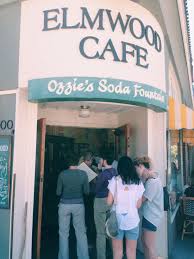
After my internet search, the Monkey Inn has become even a better memory for me. It is now the home of La Peña Cultural Center promoting social justice, arts participation and intercultural understanding. We’ve all come a long way, baby!

 Unexpected adventures sometimes lie close at hand. My first intention was to follow a good friend’s advice and check out the North Berkeley Senior Center. I had resisted crossing that threshold into senior-dom but circled the blocks north of UC Berkeley campus and found a parking spot, duly registered, and even ventured into the dining room filled with a couple hundred seniors waiting patiently for a nutritious, if not gourmet, lunch for the bargain price of $3. I headed for a table occupied by three more spritely-looking women only to discover that they were all speaking Turkish, having immigrated to the US in recent years. The one English speaker was kind enough to engage me in conversation and generously offered me the homemade Middle Eastern salad she had brought to share with her friends. These women knew how spice up life.
 At 12:30 sharp, I headed upstairs to the Center’s library, stocked by a generation that knows good literature and history, to what was advertised as the “Mixed Poets” class. No one arrived. So instead, I selected a slim volume in French, deciding that I could improve my French with a bit of translating. But I needed to find a French-English dictionary (forgetting that my iPhone had a translating app). Where to go? I drove back over to campus and headed for the Bancroft Library reading room with its thousands of reference volumes at hand. Passing under Sather Gate, I was transported back to 1963 and my sophomore year of college. I passed Wheeler Hall where I had taken a French literature class. Actually, I had only stepped into the classroom one time but had dutifully read Madame Bovary and the other selections on my own. To my dismay I discovered that 50% of the final would be based on class lectures. So I had gone to the Bancroft library, grabbed the Encyclopedia Britannica volume on French literature, boned up and passed the class with a B+. I walked passed other buildings where classes had been missed, phony excuses for non-attendance made up, and last minute cramming had taken place. Once ensconced in the beautiful vaulted reading room, I spent a few minutes using my newly found dictionary to translate the opening pages of what appeared to be a mystery novel, but then remembered my iPhone and took the easier route.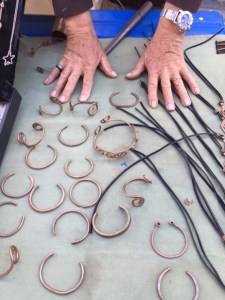
 Before our conversation ended, he insisted I take one of his authentic Gaelic bracelets as a gift. I thought of going to the ATM to get cash to pay him but then decided that only gracious acceptance was called for. The real gift was allowing myself an afternoon of being open to the small miracles that come our way when we keep our eyes, hearts, and minds open to what life offers. And, yes, I’ll return that French novel to the Senior Center library after I finish the translation. If I learn enough French, I’ll be able to understand what my three and five-year-old granddaughters are whispering about in the back seat of my car on the way to their French school.
 Dr. Karen Stephen aka Doc Flamingo